
How the Wine Writers' Symposium Helped Me Feel Like A Person Again
What a few days of wine, conversation, and shared curiosity gave back to me.

Starting a piece of writing with “my therapist says” feels more confessional than I mean it to be. I am telling you more about myself than maybe you knew before, but that’s not important. What is important is that she keeps telling me, “you are closer than you think.”
Closer to what, I’m still figuring out.
I arrived at Meadowood Napa Valley having rented a car and driven two lovely New Yorkers from SFO, which already felt like an accomplishment.
Did you know that San Francisco drivers pull unnecessarily aggressive maneuvers that would not fly in LA traffic? Because they do.
The minute I parked my rental at Meadowood, I felt like I could relax. It felt like the nice young man who grabbed my bag knew I needed to be guided toward a glass of Sauvignon Blanc and then to my room. He told me everything in the minibar was free, that someone was always available to light my fireplace, and that if I needed anything I could just call. And even with all of that, I still felt a little off. When he left, I ate half a box of dark chocolate almonds.
If this sounds like normal hotel behavior to you, then congratulations—you are used to more luxury than I am.
The Wine Writers’ Symposium is a gathering of people who care enough about wine to write about it. The way wine is interpreted, consumed, and investigated may be different, but we all think wine is important enough to dedicate time to. This year’s symposium was based on the question, “If wine were only art or only science, what would be lost?”
When I say that I came to Napa not feeling like a person, I don’t mean that I felt like some other entity. I know I’m not a ghost, or a frog, or lint. I just mean that sometimes I feel like, despite evidence to the contrary, that I have nothing real to hold on to. My grandmother had just passed, and I was only beginning to mourn. I’d been questioning what I do, if it means anything. Who do I write for and why? Is wine really that important? And the question I think most writers grapple with: what makes me think I’m even good at this?
I don’t make a living as a writer, I sell wine, so why don’t I just do the thing that pays me?
Also, if no one has told you, writing is hard.
I don’t judge anyone by their creative output, or how much money they make, or how close they are to who they thought they would be, except for myself.
I’m a judgy Judy just to me.
The first evening of the Symposium, we were hosted to dinner at Forum. The dining room was airy and comfortable. The mood of sharing and camaraderie began immediately. Each table was given a few different bottles of Napa Valley wine, and we were encouraged to swap bottles with the tables around us. Corison Winery, Mt. Veeder Winery, Dominus Estate. Swaps were made as speakers and fellows got to know each other as peers.
On the first day of sessions, I woke up early but refused to leave the giant bed. I had returned to my room the night before to find it turned down, with a freshly made gummy in a miniature burlap sack on my pillow, along with a poem and a note saying how happy they were that I was there.
I cried.


After I finally got myself out of my room and on the road, I realized I had no idea where I was going. I wandered the grounds as it got later and later. I passed the pool twice. Then a car pulled up and the window rolled down. My first instinct was to run. For a moment, I forgot I was being held tightly by the Meadowood grounds and the Napa air. It was one of the other fellows, and he gave me a ride to where we would be learning for the day.
When I finally sat down with bacon, a muffin, and a cup of black tea, I felt like it was the first day of class. I felt ready for the experience, but I also felt isolated, like I didn’t know how to show up as myself.
I didn’t expect that so much of how I felt to be addressed in the first session of the day.
Osayi Endolyn gave a talk about our collective genius. One of the most important parts of our job is human connection and the relationships that we build. Writing is about listening, investing, and sharing stories. Giving wine and food memory, place, culture, and history.
Next, Elaine Chukan Brown put language to the exact problem that had been vexing me: how do you write about wine for people who don’t already believe wine matters?
If you start from the assumption that your reader cares deeply about wine, you’ll write that way. But most people don’t care about wine like that, even if they enjoy drinking it. And if you’re not careful, you end up writing mostly for other wine writers and industry people.
There’s nothing wrong with that. It’s just not what I want to do.
Elaine’s book The Wines of California is a great illustration of writing about wine that puts wine into the context of untold history and gives a voice to the Indigenous populations that were so integral to the history of wine.
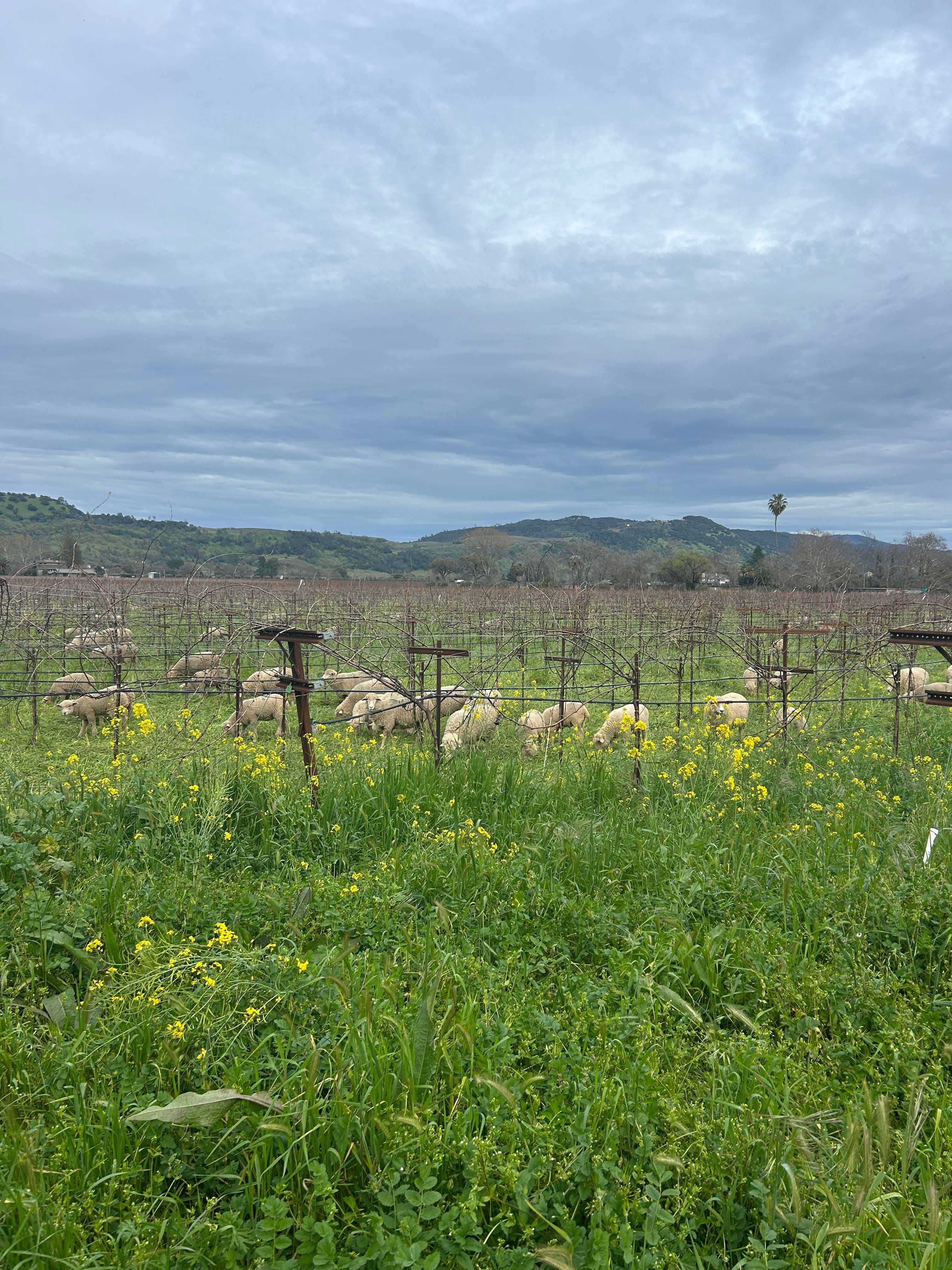
We took a walk through the Honig Vineyard. There were sheep grazing in the wildflowers and weeds growing among the vines. We heard about sustainability in Napa Valley, the importance of community collaboration, and sharing what works. Increasing biodiversity and choosing not to till or spray chemicals in your vineyard means nothing without the collective wanting to collaborate.
We had beautiful dinners at the Louise Martini tasting room and drank wines from Ballentine Vineyards, Sequoia Grove Winery, Arkenstone Estate Winery. I laughed and shared stories with the people around me.
Sharing a meal and having a conversation always makes me feel like a person again.
Dorothy J. Gaiter spoke about the art of storytelling. The way silence will allow your subject to open up in ways they may not expect. And that it’s important to ask the hard questions. Not to shy away from getting to the heart of your subject, which speaks to truly getting to know someone.
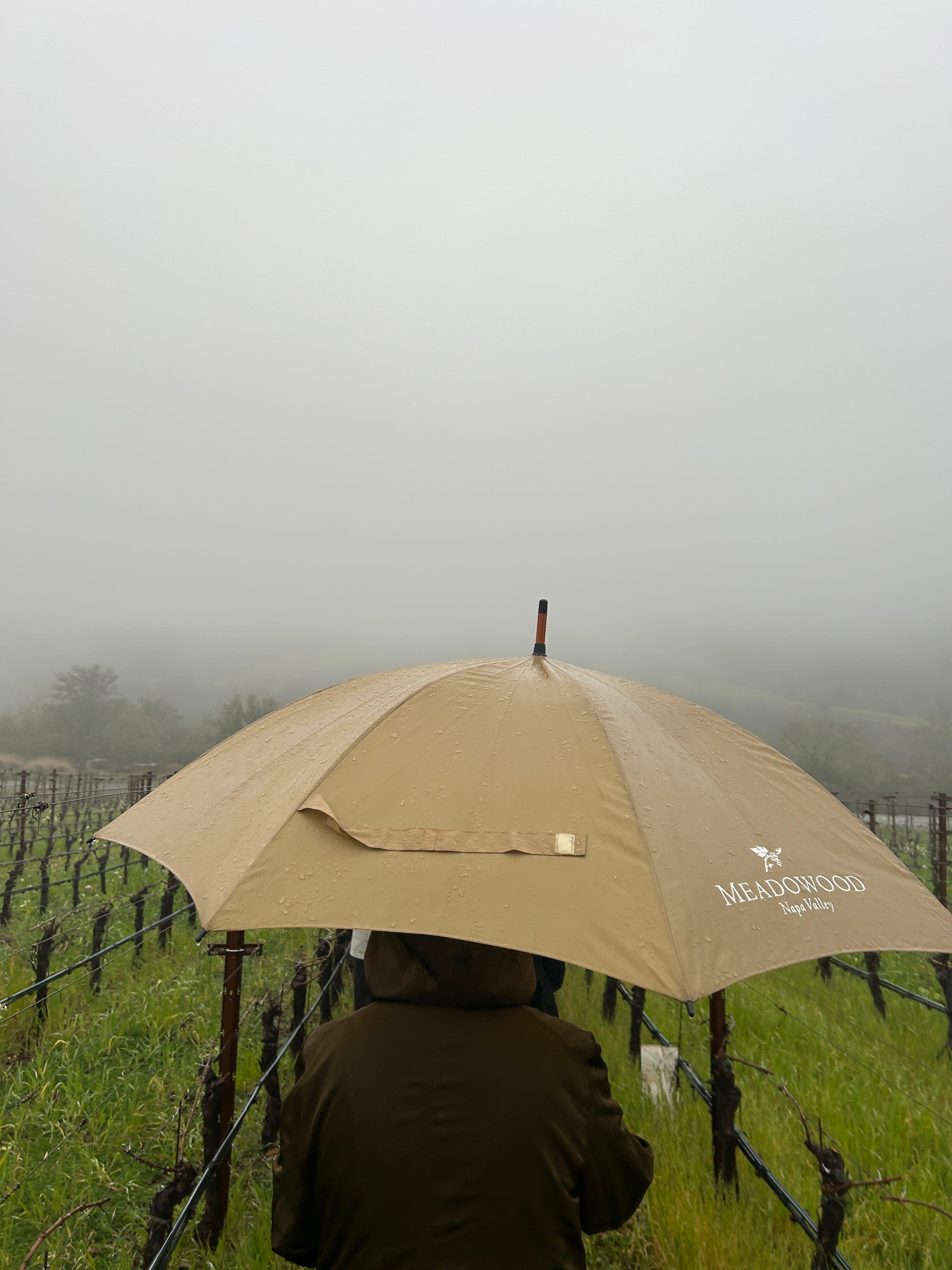
We took a stop at Continuum Estate, and Professor Alex Maltman talked to us about soil, rocks, and vines. It was a rainy day, there was fog, and while standing in a cave listening to the talk, it felt like I was in a theater again, sharing the experience of performance. I felt at once present while dreaming of what the fictional version of this would be.


The four days of the Symposium had me buzzing with all the things I would write when I was back home.
John Brecher ended our four days together with a keynote speech that brought us back to the question of art and science. He talked about how Sutter Home White Zin (of all things) was a marriage of both. That the success of the product was down to the myth-making. The creation of a story that probably had much more to do with science, but felt more electric through the lens of art. He talked about all of the untold stories that we have the power to tell.
There I go crying again.
I left Meadowood feeling energized. We gathered from all over the country to discuss wine and food, to share meals, and to learn from each other.
I left feeling like a person, a part of the whole.
This Week’s Tiny Pleasures, Vol. 8
A few books I’m excited to read from my fellow Symposium goers


Grape Juice by Eliza Dumais
The Wines of California by Elaine Chukan Brown
Love by the Glass by Dorothy J. Gaiter and John. Brecher
Kwéyòl/Creole by Nina Compton with Osayi Endolyn
What a wonderful reflection. I love your thoughts in this beautifully written piece, and I felt similarly enlivened/inspired/energized.
This was a lovely read. Many thanks. As a past participant, first as Fellow and later as Speaker, I can attest that it is truly rewarding to be immersed in the craft and community for four days—especially at that magical resort.